Posts

Prairapy Session

Image
Kimberly Writes: I came home from the Midwest Native Plant Society's conference this weekend feeling totally inspired! Seeing so many people come together in celebration of native plants, pollinators, butterflies, singing insects - and just the wonder of the natural world in general - made my heart so happy, and filled me with such a sense of hope for the natural world. I am so grateful to Kathy McDonald, Jim McCormac , Ned Keller, Yvonne Cecil, and the entire team that organizes the wonderful Midwest Native Plant Conference. I'm thankful to have been able to attend two terrific programs by Cheryl Harner  and  Lisa Rainsong . (And Kenn's keynote was wonderful, too!) Thank you all for the healthy dose of inspiration and knowledge! I decided to use my new-found inspiration as motivation to pull weeds in our prairie. Watching the transformation of half an acre of unmowed grass into a prairie has done more than restore habitat, it's restored something deep in my soul. Whe...

From Kenn's Drawing Table: Red-legged Cormorant.

Image
From Kenn's Drawing Table: Work in progress: Red-legged Cormorant.  There are about 40 species of cormorants in the world. They occur on all seven continents but they're widely dispersed, usually with no more than four species at any one locality, so it would take a lot of traveling to see them all.  By now I've seen most of them; my favorite is Red-legged Cormorant, a specialty of western South America (Peru and Chile), with a few also in southern Argentina. I had seen these birds on past trips, but when we watched them in Peru last winter, I knew I'd have to try painting them. The pattern of whitish spots on the upperparts is unique in the family, while the circle of sky-blue dots around each eye is another intriguing feature.

Eastern Meadowlark Observations

Image
From Homebase in Oak Harbor, OH, Kimberly Writes: If you haven't read my last post, please do. It explains how Eastern Meadowlarks came to nest in our "yard gone wild!" They're shockingly close to the house, allowing for wonderful observations of behavior. They seem to be most active in the early morning hours, the female bringing nest material...  ...while the male takes to a high perch some distance away to sing and chatter. The nest is built on the ground, in areas with dense grass and other low cover, in a small depression in the soil. The nest is a domed structure with the entrance on the side, made of grass stems interwoven with surrounding growth. There are typically narrow trails or runways in the grass leading to the nest. The grass is tall enough that I can't see the actual nest site yet, but the female lands some distance away a nd I can see the grass moving as she follows these trails to the general area!

The Beauty in Letting Go

Image
From Homebase in Oak Harbor, OH, Kimberly Writes:  After two weeks of neglect, our lawn, as viewed through the lens of conventional wisdom, was officially out of control. I mean, mowing your grass is what you're supposed to do, right? Yes, indeed, grass is meant for mowing, and a yard must be kept neat and tidy to conform with the ideal of what a perfect lawn is supposed to be. Our wild and unruly lawn Tell that to a Meadowlark! For here in our little three acre patch of paradise, a pair of Eastern Meadowlarks is actively building a nest. Unexpected guests to our unconventional lawn. Female with a mouthful of nest material  Leave it to the birds to remind us of the benefits of letting go. To remind us that wild and unruly could represent perfection. That conventional wisdom should be challenged now and then. And that the reward might be a bird with the sun on its breast and a song as sweet as the summer breeze.

Northwest Ohio Birding Information

Image
From Homebase in Ohio, "The Warbler Capital of the World," Kenn writes:  We're coming up on the time of year when northwestern Ohio - specifically the Lake Erie shoreline in the area of Magee Marsh Wildlife Area and Ottawa National Wildlife Refuge - becomes one of the most exciting and popular destinations for birding in North America. Longtime Ohio birders may know all about birding this region, but this year some new sources of information are available. And new birders, in particular, might want to save this post to help with planning spring birding trips. American Redstart First, if you're not familiar with the area at all, there's an overview in this feature article that I wrote for Birding , the magazine of the American Birding Association, in 2010.  The Black Swamp Bird Observatory (BSBO) provides many kinds of free information for visiting birders , including info on birding sites. The single most famous local site is the boardwalk at Magee ...

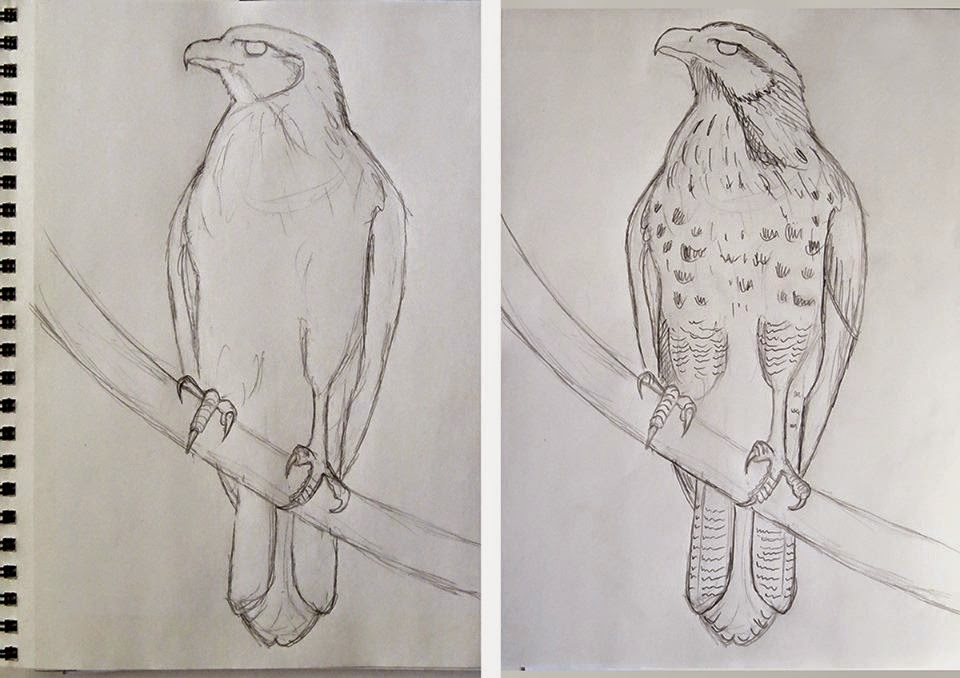
From Kenn's Drawing Table: Great Black Hawk

Image
Kenn Writes: Some bird painters can put down just a few lines on canvas or paper and then start painting. I respect that, but it doesn't work for me; I have to have a detailed idea of where things are going before I start to lay in any color. I recently started a portrait of an immature Great Black Hawk, and the basic drawing evolved over a couple of days. On the left here is the subfinal drawing. After putting it aside for a while, I decided to change the position of the head, make the bill a little thicker, and make a few other adjustments. I'll probably make more changes in the process of painting, but at least the foundation is set in advance.

Peru Trip with Wildside Nature Tours, Day 6: Screamers, Dryer Lint Birds, and Pink Dolphins

Image
Another spectacular day on the mighty Amazon River and smaller tributaries. And just wait until you see what followed along on our evening skiff ride! Ho. Lee. Cow! (Er, dolphin!) The lovely Capped Heron was a highlight bird of the trip! Masked Crimson Tanager Since this bird is closely associated with water,  traveling by boat is a great way to see it! Amazonian Umbrellabird! Cropped at a very long distance, in the shade, from a moving boat!  (Not bad for my little Canon SX50, eh?!) In addition to that wonderful crest, both males and females have an inflatable throat wattle that they extend during displays. The wattle is longer in the males, and can reach up to 14 inches.  When fully extended, the crest curls foward over the face, thus the name Umbrellabird. We were fortunate enough to get great looks at this Monk Saki Monkey.  These woolly monkeys are almost entirely arboreal, rarely going to the ground. Horned...