Posts

Diversity and the Future of Birding, part 2

From Oak Harbor, Ohio, Kenn writes: A few days ago (August 24) I wrote about the lack of diversity in the birdwatching community. This issue has bugged me for some time, but on the other hand, I’m encouraged to know some individuals who are actively doing something about it. John C. Robinson has been a friend for several years. We had corresponded before we met, so I knew he was an expert birder before I knew he was African-American. John has been a writer and consultant on a number of topics, but with his status as a black bird expert, it was perhaps only natural that he would become a spokesperson on the issue of diversity in birding and outdoor recreation. At a conservation summit before the Midwest Birding Symposium in 2003, I heard John speak on this subject, and he was very persuasive and compelling. More recently he has published a book that addresses the same issue, Birding for Everyone: Encouraging People of Color to Become Birdwatchers. It’s a thought-provoking work that of...

Living Colors: Diversity and the Future of Birding

Image
From Oak Harbor, Ohio, Kenn writes: Okay, here’s some talk about a subject that a lot of us seem to have trouble talking about. My serious interest in birds began at age six, but at first I birded alone. Then as a young man I was traveling and meeting other birders just a few at a time. So after two decades I still didn’t have a real sense of what the birding community was like. Finally by about the time I hit thirty, I was getting invited to speak to bird clubs and birding festivals all over the continent, and it dawned on me: Wow, we’re practically all white people here. Once I had noticed, it was strikingly obvious. I’d be doing a bird program for an audience of 200 in New York, or South Carolina, or Alabama, or Chicago, and I’d realize that there wasn’t a single black face in the crowd. Or I’d be talking to a large group at a bird meeting in California or Arizona or Texas, and there would be hardly a face in the room that looked Hispanic or Native American. The situation remains ...

Green Season in Trinidad and Tobago

Image
From back home in Ohio, Kenn writes: Most birding tours to Trinidad and Tobago (T & T) are planned for winter or early spring. That’s the season when you can expect the highest total number of species, because the local resident birds are joined by migrants from the north -- padding the list with birds that you could have seen back in Ohio or New Jersey during the summer. People who judge the success of a birding trip by the sheer number of species seen (we’re not among them) might see that as reason enough to go to Trinidad in winter. Winter and early spring are the seasons when most other tourists go to T & T also. Partly they go in winter to escape the cold weather up north. But another factor is that the other half of the year, June through November, is what used to be referred to as Trinidad’s rainy season. I say "used to be" because we’ve changed it. That half of the year is now known as the "Green Season." Yeah, there’s some rain. But we just spent ...

Touching the Graceful Monsters

Image
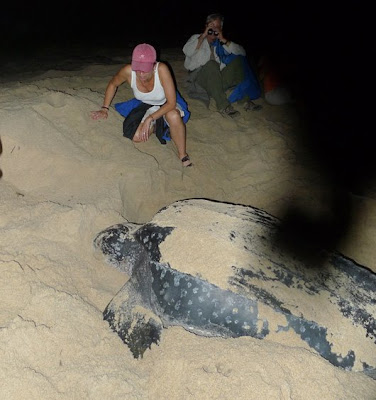
From amid a huge file of still-unprocessed photos, Kenn writes: Baby leatherback sea turtles hatch out of eggs buried in sand and start a desperate scramble down the beach toward the water, and if they make it, they may not see land again for years. During those years they are maturing from palm-sized rubber toys into enormous sea monsters. Full-grown adult leatherbacks are the world’s largest turtles, up to seven feet long and weighing up to a ton. They are also the most wide-ranging turtles on the planet, found almost throughout the world’s oceans, traveling from the tropics to the edges of the polar regions. They are also, throughout their vast range, seriously endangered. With streamlined leathery shells and powerful front flippers, the leatherbacks can fly through the depths with astonishing grace and speed, diving to more than half a mile below the sea surface and staying submerged for more than an hour. Their great size is no hindrance in the sea, where they are the most gracefu...

Eye-burners of Caroni

Image
From the Asa Wright Nature Centre, Trinidad, Kenn writes: Birding in Trinidad is turning out to be even more fun than I’d expected. I started reading about Trinidad -- and about the Asa Wright Nature Centre -- when I was just a kid. The center was established in 1967, making it one of the first nature centers anywhere in the tropics, and I first heard about it as a place that people would go for their introduction to tropical birds. But I had my tropical-bird intro in Mexico, since (as a penniless teenager) I could hitch-hike to the border and then take the cheap buses south. Later, when I ventured deeper into the tropics, I went to Peru and Ecuador and Venezuela, not to Trinidad. Working as a professional leader of birding tours, it made more sense for me to take groups to Venezuela (with a total bird list of over 1400 species) than to the island of Trinidad, just off the Venezuelan coast (with a total bird list of fewer than 500 species). So even though I knew Trinidad was famous fo...

HEY!!!! We're back!!

Image
From the Asa Wright Nature Centre in Trinidad, Kim Writes: Well, as indicated by our total lack of blog presence in recent weeks, Kenn and I were totally wiped out by the spring season this year. (and hey, to all those who sent loving, caring messages saying that they missed our posts...THANK YOU! --- and to all those who actually sent us hate mail...can I just say, "GEEZE, HATERS! GO OUTSIDE AND LOOK AT BIRDS, FOR GOODNESS SAKES!) There...I just had to get that off my chest. So, anyway.... We were thrilled beyond belief by the record visitation to our magical area this spring! But, we were both beginning to wonder if we'd ever get out from under the avalanche of work that collapsed on us in mid-June. We held it off as long as we could, but it eventually came crashing down, and by the first of July, we were both ready for a little down time, and trying to decide where we could go for a little R.R&B. (rest, relaxation, and birds!) Enter our friend Jeff Bouton, and Leica Sp...

Endless Spring

Image
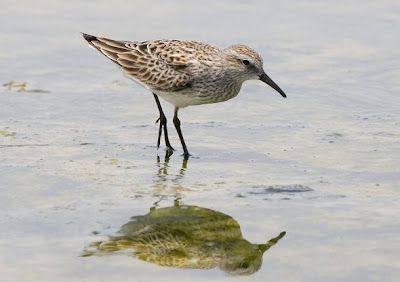
Summer? Says who? For this White-rumped Sandpiper, this is still the season of spring migration. From the middle of a flooded field in northern Ohio, Kenn writes: After a totally crazy month, the calendar has just clicked over from May -- we call it May-hem around here -- to June. So what season is it now? If you’re a White-rumped Sandpiper, it’s still spring, still the height of northward migration season. Of course, if you’re a White-rumped Sandpiper, you’re probably not reading this blog. If you’re a sandpiper, you’re too busy to read things like this. Especially if you’re a White-rumped. More than three dozen different species of sandpipers are found regularly in North America; all of them are at least somewhat migratory. None of them migrates north later in spring, on average, than the White-rump. This bird has a lot of distance to cover. Its wintering sites are all in southern South America, including some as far south as the tip of the continent -- or even farther: this amazin...